 FishTank
CO2 and fertilizer for planted tanks: a beginner's guide
Do aquarium plants need CO2? Most beginner plants don't. What they do need is the right balance of light, fertilizer and carbon. Get that balance right and plants grow; get it wrong and you grow algae instead. Here's the simple version.
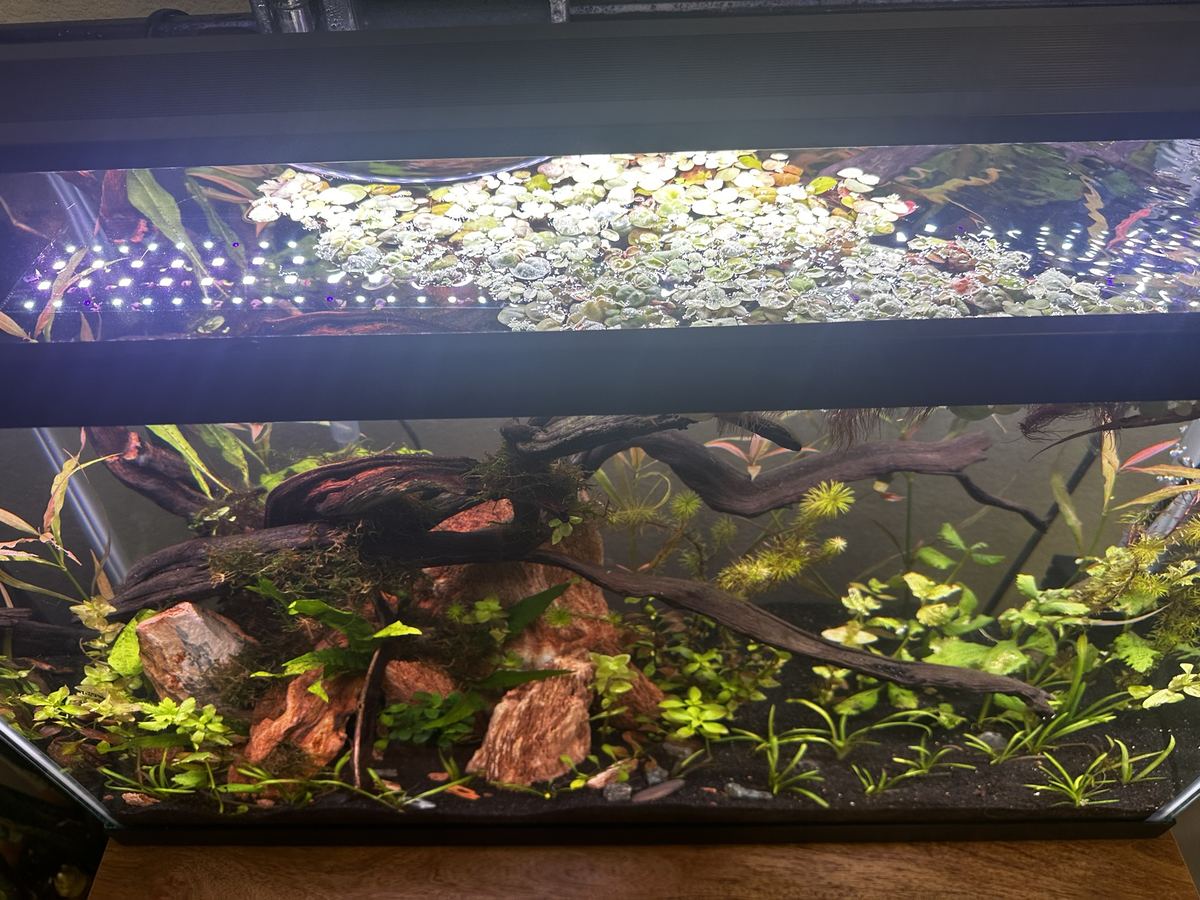
All but two of my 18 tanks are planted, and only one of them runs CO2. The rest grow fine on light, fertilizer and fish waste.
The three things plants need
Plants need light, nutrients (fertilizer) and carbon (CO2). Growth is limited by whichever one runs out first. More light without more nutrients and CO2 doesn't make plants grow faster. The leftover light feeds algae. That's why the golden rule is to start with modest light and add the others to match.
Low tech or high tech?
| Low tech | High tech | |
|---|---|---|
| Light | Low to medium, 6–8 hours | Strong, 6–8 hours |
| CO2 | None added | Pressurized CO2 |
| Fertilizer | Weekly liquid and root tabs | Several doses a week |
| Plant growth | Slow and steady | Fast; lots of trimming |
| Algae risk | Low | High if anything is off |
| Good for | Beginners and most tanks | Carpets and red stem plants |
Start low tech. Plants like anubias, java fern, cryptocorynes, Amazon swords and floating plants all grow well without added CO2. See easy aquarium plants for beginners.
Fertilizer: liquid or root tabs?
- Liquid fertilizer feeds plants that take nutrients from the water: floating plants, stem plants, and plants tied to wood like java fern and anubias. Dose it once or twice a week, after your water change. Seachem Flourish is a common choice.
- Root tabs are capsules you push into the gravel near plants that feed from their roots: swords, cryptocorynes and grass-like plants. Replace them about every 3 months. See Flourish Tabs.
- Plant soil like Fluval Stratum has nutrients built in, but they run out after a year or so. Then add root tabs. See the best gravel and sand and the substrate calculator.
Most planted tanks do best with both liquid fertilizer and root tabs. Start with half the dose on the bottle and increase slowly if plants still look hungry.
Signs your plants are hungry
| What you see | Likely cause |
|---|---|
| Older leaves turn yellow from the tip | Not enough nitrogen. Common in tanks with few fish. |
| Pinholes in leaves, then yellow edges | Not enough potassium |
| New leaves pale or white, veins green | Not enough iron |
| Leaves melt soon after planting | Usually normal for new crypts. Leave the roots and they regrow. |
| Slow growth and fuzzy algae on leaves | Too much light for the CO2 and fertilizer |
Liquid carbon
Liquid carbon products (glutaraldehyde, sold as Seachem Excel and similar) give plants a little extra carbon without a CO2 system and can help fight some algae. They're optional. Follow the bottle dose exactly, and know that some plants, like vallisneria and some mosses, can melt from it.
Pressurized CO2: when it's worth it
A CO2 system is a gas cylinder, a regulator with a solenoid that turns it off at night, a bubble counter and a diffuser. It's worth it when you want a carpet of tiny plants, bright red stem plants or very fast growth. It's not worth it for a first tank.
- Turn CO2 on about an hour before the lights and off an hour before lights out, using the solenoid and a timer.
- Use a drop checker. It turns lime green when CO2 is about right, and yellow when there's too much.
- Too much CO2 suffocates fish. If fish gasp at the surface, turn the CO2 off and add surface movement. See fish gasping at the surface.
- Skip the DIY yeast bottles and disposable cartridges for anything bigger than a small tank. They're hard to keep steady.
A simple weekly routine
- Run the light 6 to 8 hours a day on a timer.
- Do a 25% water change.
- Dose liquid fertilizer after the water change.
- Trim dead or melting leaves.
- Add root tabs every 3 months.
If algae shows up, cut the light first. See aquarium algae types and fixes.
Planted tank picks
Paid links: if you buy through these Amazon links, I earn a small commission at no extra cost to you.
- Liquid fertilizerSeachem Flourish plant fertilizerA gentle all-round liquid fertilizer. One bottle lasts a small tank many months.
- Root tabsSeachem Flourish Tabs (40 pack)Root tabs for swords, crypts and other rooted plants.
- Light timerBN-LINK 24-hour outlet timer (2 pack)Keeps the light on the same hours every day, the easiest way to prevent algae.
- Plant soilFluval Plant and Shrimp Stratum, 8.8 lbPlant and shrimp soil with nutrients built in, for a new planted tank.

Related: Easy aquarium plants · Best aquarium lights · Algae types and fixes